General

US President Barack Obama spoke in Seoul today, promising to pursue nuclear cuts, an issue he will push in a May meeting slated with incoming Russian President Vladimir Putin. Pakistan’s legislators are debating ties with the US, specifically with respect to re-opening NATO supply routes that have been closed since a US attack killed 24 soldiers in Pakistan last November. Iranian President Mahmoud...

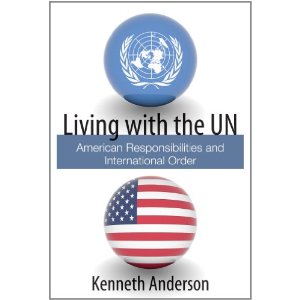
My book, Living With the UN: American Responsibilities and International Order, is now in stock and on-sale at the Hoover Institution Press website.  I have a copy in hand and I’m delighted to be holding it.  It’s not quite like holding your new baby – but for an inanimate object, it’s closer than you might have thought.  (Julian - feel free to weigh in here: I'm thinking having one's new book in hand is kind of like holding one of those Japanese roboticized teddy bears for soothing the elderly with dementia, but maybe that's just me.) It will be a couple of weeks – April 17 – before it's available through Amazon, Barnes & Noble, and other online sellers.  A Kindle edition will be released on April 17 as well.  Over the next couple of months, I will be talking about various themes in the book – UN-US relations, the nature of the UN, the different ways in which the US should engage (or not) with different parts and functions of the UN.  Julian will be doing the same with his and John Yoo's provocative new book, Taming Globalization, so expect to hear a lot at OJ about themes in our books (we have, btw, covertly set up an algorithm in which the more OJ readers buy our books, the less we will talk about them!).  To start with, however, I wanted to go to a very different topic – this one about publishing, choosing a publisher, and why I chose the Hoover Institution Press.  This follows on some excellent guest posts by senior academic press editors in the past here at OJ - I'm really extending my take on those past discussions. I'm hoping that my thinking here will be useful to some OJ readers thinking about publishing. This is a policy essay, not a “scholarly” book – it has about twenty footnotes for the whole thing, and a bibliography of secondary sources aimed to be accessible to those without a university research library or knowledge of how the UN online archives work.  My interest in this case is dissemination of the ideas in the book, not staking out academic turf.  So my general choices were three: One, find a commercial trade publisher, which seemed improbable given the subject matter, the way it is written, and my lack of trade press publishing in the past.  Two, find a university or academic press; this seemed like the obvious thing, and in fact there were several options that direction, notwithstanding that this is something like the opposite of the dense academic monograph.  Third, go with a think tank policy press in which case, given the history of the project and my affiliations, it would be Hoover. The Hoover publishing folks have been marvelous.  They have been fabulous on production values, editing and copy editing, all the professional production elements.  They have been patient to a fault in waiting for the manuscript and letting me make later changes.  And they have excellent marketing staff and have a commitment to getting the book out there in a way that is only sometimes true of academic presses whose primary audiences are academics and university libraries.  But several academic presses are great in all these ways, too, so one has to ask, why consider a think tank press?  After all, isn’t a think tank press – even one associated with a university, like Hoover, and moreover a conservative think tank – taking a hit in academic prestige and respectability?

A new feature this week on Opinio Juris is the Weekday News Wrap. The latest edition, with links to the earlier ones, can be found here. At the beginning of the week, we continued last week’s roundtable discussion of the ICC’s Lubanga Judgment. Cecile Aptel discussed the split between the judges on whether the charge of using children “to participate actively...

We hope you enjoyed this first Opinio Juris/LJIL Online Symposium. For those who want to prolong these debates in real life, while waiting for the next online symposium, the Leiden Journal of International Law (LJIL) will celebrate its 25th anniversary on 30 March 2012 during the American Society of International Law's Annual Meeting. The journal will host a casual roundtable...

The International Court of Justice issued two press releases about upcoming hearings in both the Frontier Dispute (Burkina Faso/Niger), scheduled for October 8-17, 2012; and the Maritime Dispute (Peru v. Chile), scheduled for December 3-14, 2012. Reuters reports a three-way scramble for the upcoming World Bank presidential elections, with American economist Jeffrey Sachs registered as a candidate. African finance ministers have...

A few months ago, I mentioned here on Opinio Juris a new feature of the ASIL Annual Meeting that we’re introducing this year:  ASIL IDEAS:  Idea, Direction, Engagement, Action, Solutions. These shorter talks, about 20 minutes long, will feature innovative ideas international lawyers will want to think about from people you might not otherwise hear.  Speakers will be drawn from a broad...

Jhesus-Maria, King of England, and you, Duke of Bedford, who call yourself regent of the Kingdom of France, you, Guillaume de la Poule, count of Suffort, Jean, sire of Talbot, and you, Thomas, sire of Scales, who call yourselves lieutenants of the Duke of Bedford, acknowledge the summons of the King of Heaven.  Render to the Maid here sent by...

In a military coup, soldiers have claimed to have overthrown the president of Mali, Amadou Toumani Toure. Libya resists ICC’s custody claims in cases against Seif al-Islam el-Qaddafi and Abdullah Senussi. Al-Qaeda has taken responsibility for dozens of bombings across Iraq, which have killed at least 52, leading up to the Arab League summit in Baghdad. China’s Justice Ministry has ordered all lawyers...

Mauritania has agreed to extradite ex-Libyan chief-of-intelligence Abdullah al-Senussi to Libya. The Economist outlines the world’s biggest arms exporters based on a new report from the Stockholm International Peace Research Institute. US President Barack Obama is slated to visit the demilitarized zone between North and South Korea today ahead of his upcoming visit with South Korean president, Lee Meyung-Bak. Western powers diluted the...

Amnesty International says that NATO failed in its obligation to investigate or provide compensation for deaths in Lybia during its seven-month operation last year. A court in Zimbabwe convicted six activists of trying to unseat Robert Mugabe through Arab Spring-like protests. The convicted men face up to 10 years in prison. India may follow China's example and ask its airlines not to...

[Dov Jacobs is an Assistant Professor of International Law at Leiden University] This first part of the symposium will provide an opportunity to discuss some aspects of what is considered to be one of the key judgments of the ICJ, some 25 years after it was issued. The two comments you will read today, from John Dugard and André Nollkaemper are in...

[Mark Kersten is a PhD student in International Relations at the London School of Economics] International lawyers will undoubtedly pour over the landmark verdict handed down this week by the International Criminal Court, in which Thomas Lubanga Dyilo was found guilty of conscripting, enlisting and using child soldiers in the long-standing and brutal conflict in the Democratic Republic of Congo. The...