25
Mar

Recent Posts
24
Mar
Why I Went With Hoover Institution Press to Publish ‘Living With the UN’
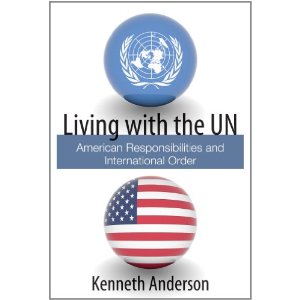 My book, Living With the UN: American Responsibilities and International Order, is now in stock and on-sale at the Hoover Institution Press website. I have a copy in hand and I’m delighted to be holding it. It’s not quite like holding your new baby – but for an inanimate object, it’s closer than you might have thought. (Julian - feel free to weigh in here: I'm thinking having one's new book in hand is kind of like holding one of those Japanese roboticized teddy bears for soothing the elderly with dementia, but maybe that's just me.)
It will be a couple of weeks – April 17 – before it's available through Amazon, Barnes & Noble, and other online sellers. A Kindle edition will be released on April 17 as well. Over the next couple of months, I will be talking about various themes in the book – UN-US relations, the nature of the UN, the different ways in which the US should engage (or not) with different parts and functions of the UN. Julian will be doing the same with his and John Yoo's provocative new book, Taming Globalization, so expect to hear a lot at OJ about themes in our books (we have, btw, covertly set up an algorithm in which the more OJ readers buy our books, the less we will talk about them!). To start with, however, I wanted to go to a very different topic – this one about publishing, choosing a publisher, and why I chose the Hoover Institution Press. This follows on some excellent guest posts by senior academic press editors in the past here at OJ - I'm really extending my take on those past discussions. I'm hoping that my thinking here will be useful to some OJ readers thinking about publishing.
This is a policy essay, not a “scholarly” book – it has about twenty footnotes for the whole thing, and a bibliography of secondary sources aimed to be accessible to those without a university research library or knowledge of how the UN online archives work. My interest in this case is dissemination of the ideas in the book, not staking out academic turf. So my general choices were three: One, find a commercial trade publisher, which seemed improbable given the subject matter, the way it is written, and my lack of trade press publishing in the past. Two, find a university or academic press; this seemed like the obvious thing, and in fact there were several options that direction, notwithstanding that this is something like the opposite of the dense academic monograph. Third, go with a think tank policy press in which case, given the history of the project and my affiliations, it would be Hoover.
The Hoover publishing folks have been marvelous. They have been fabulous on production values, editing and copy editing, all the professional production elements. They have been patient to a fault in waiting for the manuscript and letting me make later changes. And they have excellent marketing staff and have a commitment to getting the book out there in a way that is only sometimes true of academic presses whose primary audiences are academics and university libraries. But several academic presses are great in all these ways, too, so one has to ask, why consider a think tank press? After all, isn’t a think tank press – even one associated with a university, like Hoover, and moreover a conservative think tank – taking a hit in academic prestige and respectability?
My book, Living With the UN: American Responsibilities and International Order, is now in stock and on-sale at the Hoover Institution Press website. I have a copy in hand and I’m delighted to be holding it. It’s not quite like holding your new baby – but for an inanimate object, it’s closer than you might have thought. (Julian - feel free to weigh in here: I'm thinking having one's new book in hand is kind of like holding one of those Japanese roboticized teddy bears for soothing the elderly with dementia, but maybe that's just me.)
It will be a couple of weeks – April 17 – before it's available through Amazon, Barnes & Noble, and other online sellers. A Kindle edition will be released on April 17 as well. Over the next couple of months, I will be talking about various themes in the book – UN-US relations, the nature of the UN, the different ways in which the US should engage (or not) with different parts and functions of the UN. Julian will be doing the same with his and John Yoo's provocative new book, Taming Globalization, so expect to hear a lot at OJ about themes in our books (we have, btw, covertly set up an algorithm in which the more OJ readers buy our books, the less we will talk about them!). To start with, however, I wanted to go to a very different topic – this one about publishing, choosing a publisher, and why I chose the Hoover Institution Press. This follows on some excellent guest posts by senior academic press editors in the past here at OJ - I'm really extending my take on those past discussions. I'm hoping that my thinking here will be useful to some OJ readers thinking about publishing.
This is a policy essay, not a “scholarly” book – it has about twenty footnotes for the whole thing, and a bibliography of secondary sources aimed to be accessible to those without a university research library or knowledge of how the UN online archives work. My interest in this case is dissemination of the ideas in the book, not staking out academic turf. So my general choices were three: One, find a commercial trade publisher, which seemed improbable given the subject matter, the way it is written, and my lack of trade press publishing in the past. Two, find a university or academic press; this seemed like the obvious thing, and in fact there were several options that direction, notwithstanding that this is something like the opposite of the dense academic monograph. Third, go with a think tank policy press in which case, given the history of the project and my affiliations, it would be Hoover.
The Hoover publishing folks have been marvelous. They have been fabulous on production values, editing and copy editing, all the professional production elements. They have been patient to a fault in waiting for the manuscript and letting me make later changes. And they have excellent marketing staff and have a commitment to getting the book out there in a way that is only sometimes true of academic presses whose primary audiences are academics and university libraries. But several academic presses are great in all these ways, too, so one has to ask, why consider a think tank press? After all, isn’t a think tank press – even one associated with a university, like Hoover, and moreover a conservative think tank – taking a hit in academic prestige and respectability?
24
Mar
Weekend Roundup: March 17-23, 2012
A new feature this week on Opinio Juris is the Weekday News Wrap. The latest edition, with links to the earlier ones, can be found here. At the beginning of the week, we continued last week’s roundtable discussion of the ICC’s Lubanga Judgment. Cecile Aptel discussed the split between the judges on whether the charge of using children “to participate actively...
23
Mar
LJIL Symposium: The Debate Continues at ASIL on March 30, 2012!
We hope you enjoyed this first Opinio Juris/LJIL Online Symposium. For those who want to prolong these debates in real life, while waiting for the next online symposium, the Leiden Journal of International Law (LJIL) will celebrate its 25th anniversary on 30 March 2012 during the American Society of International Law's Annual Meeting. The journal will host a casual roundtable...
23
Mar
LJIL Symposium: James Stewart Responds to Jens Ohlin
[James G. Stewart is Assistant Professor of Law at the University of British Columbia] Jens Ohlin, with George Fletcher and in his own right, has been a pioneer in bringing criminal theory to bear on international criminal justice. His earlier work warned us that our dogmatic insistence on ascertaining international criminal law in pre-existing sources of public international law risked undermining the inherently criminal nature of this adjudicative process and the fundamental notions of criminal law that must apply as a consequence. As is the case with the other critics who have written for this blog, my article is counterfactually dependent on his earlier groundbreaking work. I think it appropriate to start by placing Ohlin’s comments in context. His admirable defense of the differentiated model of blame attribution presently in place in international criminal justice does not take into account that arguably the most prominent theorists even within his own jurisdiction, from Michael Moore to Sandy Kadish and Larry Alexander, all view complicity as conceptually superfluous. This does not respond in any way to Ohlin’s comments, but I do think it important to table the growing body of authoritative academic argument against the differentiated model international courts have unquestioningly absorbed. In many respects, my article is an attempt to do just that. On another preliminary note, I fear that Ohlin’s criticisms might miss the real essence of the paper. Most importantly, he does not address the normative substance of “modes of liability” in international criminal justice. Both the title to his response (“Names, Labels, and Roses”), and the content of his remarks under that heading imply that the issue is just one of nomenclature, as if there were no normative significance to convicting someone of genocide for recklessly assisting the crime. But the major argument in my paper is that in its extremities, complicity violates the same standards that commentators have used to criticize the overreach of other “modes of liability” within the discipline, and that consequently, this mode of liability too is sometimes unjustifiably harsh or simply unprincipled.
23
Mar
LJIL Symposium: Names, Labels, and Roses
[Jens David Ohlin is Associate Professor of Law at Cornell Law School; he blogs at LieberCode] In his excellent essay, James Stewart advocates for a unitary model of perpetration. To the extent that this means the end of modes of liability, so be it says Stewart. We don’t need them. They codify distinctions that we don’t need, promote confusion over coherence, and so we should instead streamline the centrifugal doctrines into a single account of causal contribution. On the elegance scale, Stewart’s proposal should score a 10 from most judges. Stewart pitches his account as revisionary, an attempt to right the ship after years of confusing scholarly and judicial debate about modes of liability and the difference between principals and accessories (or other categories that occupy similar conceptual space). But I think that it is the wrong light in which to see the argument. I see Stewart’s proposal as urging return to a substantially similar state of affairs under the original Joint Criminal Enterprise scheme proposed by the Tadic Appeals Chamber during the early days of the ICTY. Cassese was the prime mover behind the JCE doctrine, and it covered all members of the collective endeavor, regardless of their level of contribution. Eventually, the doctrine was modified to require a heightened contribution requirement, and eventually the leadership level defendants were “de-linked” from the foot soldiers and placed in separate JCEs. But the important point is that the original JCE doctrine included everyone from an architect of the crime (mastermind or hintermann) as well as the foot soldiers or what the later ICTY cases often referred to as the Relevant Physical Perpetrators, or RPP. So under the original JCE doctrine, each member of the group was prosecuted for participating in the JCE. That was, in essence, a unitary model of perpetration. True, as a formal matter, aiding and abetting and accomplice liability survived the creation of JCE, but their relevance and practical import was greatly reduced. Most defendants at the ICTY were prosecuted under a JCE theory and it seemed to me that in most cases JCE could have replaced the other modes of liability given the collective nature of international crimes.
23
Mar
Weekday News Wrap: Friday, March 23, 2012
The International Court of Justice issued two press releases about upcoming hearings in both the Frontier Dispute (Burkina Faso/Niger), scheduled for October 8-17, 2012; and the Maritime Dispute (Peru v. Chile), scheduled for December 3-14, 2012. Reuters reports a three-way scramble for the upcoming World Bank presidential elections, with American economist Jeffrey Sachs registered as a candidate. African finance ministers have...
22
Mar
Should We Resist the “White Savior Industrial Complex”?
I found much to like and dislike in this essay by Nigerian-American writer Teju Cole discussing his widely shared tweets on the Invisible Children Kony 2012 video. Here is one: Teju Cole@tejucole 1- From Sachs to Kristof to Invisible Children to TED, the fastest growth industry in the US is the White Savior Industrial Complex. Cole goes on to observe (rightly in my...
22
Mar
Inaugurating ASIL IDEAS
A few months ago, I mentioned here on Opinio Juris a new feature of the ASIL Annual Meeting that we’re introducing this year: ASIL IDEAS: Idea, Direction, Engagement, Action, Solutions. These shorter talks, about 20 minutes long, will feature innovative ideas international lawyers will want to think about from people you might not otherwise hear. Speakers will be drawn from a broad...
22
Mar
How To Declare War (Anno Domini, 1429)
Jhesus-Maria, King of England, and you, Duke of Bedford, who call yourself regent of the Kingdom of France, you, Guillaume de la Poule, count of Suffort, Jean, sire of Talbot, and you, Thomas, sire of Scales, who call yourselves lieutenants of the Duke of Bedford, acknowledge the summons of the King of Heaven. Render to the Maid here sent by...
22
Mar
LJIL Symposium: James Stewart Responds to Thomas Weigend
[James G. Stewart is Assistant Professor of Law at the University of British Columbia] I start my reaction to Thomas Weigend’s comments by insisting on my great gratitude to him. In his earlier comments on a draft of this article, he offered criticisms that were far more extensive that those he gently revealed in this blog (or that I have ever received for an article before). Although my final piece does not adequately respond to all his misgivings, I confess that I may have learned at least as much from his extensive criticisms as I did from the voluminous literature required to write this. In acknowledging his great intellectual generosity, let me nonetheless offer some response to portions of his criticism. Professor Weigend starts by suggesting that the “way out” offered by a unitary theory of perpetration is intuitively compelling because of its simplicity. What law student, attorney or judge would disagree, he asks, would deny that these differentiated modes of liability are really not easy? Here, I fear that he perhaps inadvertently reduces my argument to a mere distaste for complexity. But my goal is not simplicity for simplicity’s sake—I am also minded to ensure that international modes of liability consistently respect culpability, to halt the fractured development of modes of liability internationally from one fad to another and to suggest a means of unifying standards of blame attribution across the many jurisdictions that can prosecute these crimes.
22
Mar