04
Feb

International Human Rights Law
04
Feb
AJIL Symposium: Can the ECOWAS Court Revive Regionalism Through Human Rights?
[Dr. Horace S. Adjolohoun is a Senior Legal Expert at the African Commission on Human and Peoples’ Rights. He recently completed his LLD thesis on Giving Effect to the Human Rights Jurisprudence of the ECOWAS Court of Justice: Compliance and Influence at the University of Pretoria.] I agree with Alter, Helfer and McAllister that progressive judicial lawmaking may be risky, particularly in an environment where domestic politics are not in favor of a supranational court that limits the sovereignty margin of state organs. In the context of the ECOWAS Court of Justice (ECCJ), an interesting question could therefore be whether, by a purposive adjudication, the Court could read community law through its human rights mandate. The Court has repeatedly given a negative answer, and many have warned of the related risks, particular bearing in mind the fall of the SADC Tribunal. An association of factors makes me suggest that the chance could be worth taking. The ECCJ is the official judicial body in which ECOWAS has vested the mandate to oversee the interpretation and application of norms adopted under the aegis of the Community (‘original’ Community law). I suggest that the African Charter has acquired the status of Community law because of its 'constructive' incorporation in ECOWAS instruments, particularly the 1993 Revised Treaty and the 2001 Governance Protocol. On the basis of the 2005 Court Protocol, the ECCJ has confirmed that status through its successive human rights judgments, starting from the first one in 2005. Article 31(1) VCLTTreaty law commands that interpretation of conventions should follow the ordinary meaning and not expand beyond the initial intention of the parties. Particularly, in the framework of regional integration arrangements, the ‘agency’ doctrine suggests that the Agent (here the ECCJ) may not usurp legislative functions by either interpreting the silence of the law in a particular direction (which I argue the ECCJ did in the Ugokwe case) or – and thereby – generating new norms that were not expressly formulated by law-makers (here, state parties) (see Stone Sweet, 10-15). Some of the authors of the lead article support that approach in a previous work. I agree that the silence of the 2005 Protocol regarding the well established international customary law rule of exhaustion of domestic remedies is as plain as was the lack of direct access for private litigants in the Afolabi era. Despite this, the ECCJ’s judges espoused purposive – and, in my view, ‘progressive’ – judicial lawmaking regarding exhaustion. The ECOWAS human rights ‘regime’ borrows from the African Charter-based system, which poses seven admissibility requirements for complaints to be accepted by the African Court and Commission. In the practice of the Commission, the rule of exhaustion is by far the one that attracts more contention. The 2005 ECCJ Protocol provides for ‘non-anonymity’ and ‘non-pendency’ as the two admissibility conditions. From the foregoing, it is surprising that, in the course of lawmaking, ECOWAS states provided expressly for two ‘minor’ conditions, and remained silent for a ‘major’ condition, which has always attracted dispute.
03
Feb
AJIL Symposium: Regional Courts, Regionalism, Critical Junctures and Economic Integration in Africa
[Dr. Kofi Oteng Kufuor is a Professor at the University of East London, UK.] In November 2013 the ECOWAS Community Court of Justice threw out a case brought before it by Nigerian traders seeking a judgment that Ghana’s investment legislation which discriminated against ECOWAS nationals was inconsistent with ECOWAS law. The decision by the Court was surprising not only on account of it being a setback to the ECOWAS goals of a single economic market but it was also a blow to the supranational regime that the members created with the adoption of the Revised ECOWAS Treaty. Moreover, this decision was even more astonishing as it went against ECOWAS law and related protocols on the free movement of persons, right of residence and establishment. The decision was also surprising in the wake of the efforts by the Court, carefully outlined in the paper “A New International Human Rights Court for West Africa: The ECOWAS Community Court of Justice" by Alter, Helfer and McAllister (AHM), to extend its power. The research by AHM states that in the early stages of the Court’s power grab, economic union was sacrificed for the protection of human rights. At the core of the paper by AHM is that a constellation of actors, driven by a variety of interests, came together at a critical juncture in ECOWAS politics – there was widespread concern about the respect for human rights and humanitarian law - and this meeting of persons and policy space created an opportunity for the Court to expand its reach into the realm of human rights. However, if we accept the core arguments of public choice theory then the Court could have exploited the petition before it to seize more power for itself. Thus public choice theorists studying international organizations will be surprised to see that this supranational moment has slipped especially with regard to an organization that still has compliance and legitimacy problems. AHM assert that the decision to allow private interests to bring human rights suits before the ECOWAS Court was done at the expense of the Court serving as an engine for realizing the economic integration objective. The inference from this is that while a critical juncture appeared and thus an opportunity seized in the name of human rights, a similar opportunity is yet to come into existence for economic interests. However, looking at the rejection of the traders’ suit from a non-economic “irrational” point of view, the ECOWAS Court has struck a blow for re-connecting markets to society by abating neoliberal economic openness that subordinate Ghana’s investment law to ECOWAS law. Was the Court able to do so because the kind of interests that birthed the Court’s rights moment did not exist at the regional level? Inferred from AHM’s work the answer seems to be yes.
03
Feb
OTP Asks for Perisic Reconsideration — On the Basis of Nothing
Fresh from its victory in Sainovic, the ICTY Office of the Prosecutor (OTP) has now asked the Appeals Chamber to reconsider its final judgment in Perisic on the ground that it would be unjust to permit Perisic to remain acquitted. As the legal basis for such reconsideration 11 months after final judgment, the OTP cites...
03
Feb
AJIL Symposium: Comment on “A new International Human Rights Court for West Africa”
[Dr. Solomon T. Ebobrah is a Senior Lecturer at Niger Delta University.]To date, ‘A new International Human Rights Court for West Africa: The ECOWAS Community Court of Justice’ authored by Karen Alter, Larry Helfer and Jacqueline McAllister is arguably the most eloquent scholarly exposition on the human rights jurisdiction of the ECOWAS Court of Justice (ECCJ) by observers from outside the African continent. This brilliant piece of work is to my knowledge, also the only one yet in existence to have taken a multi-disciplinary approach to the study of the ECCJ. Based on their very thorough and painstaking empirical investigation, the authors have successfully (in my view) supplied answers to some of the nagging questions that political scientists and lawyers would have regarding the budding human rights mandate of the ECCJ. As they point out in their opening remarks, intrigued (as the rest of us are) by the sharp but successful redeployment of the ECCJ from its original objectives of providing support economic integration to a seemingly more popular but secondary role as an international human rights court, the authors apply this article for the purpose trying understand and explain the rationale and manner of this transformation.
The authors have made very compelling arguments in support of their theoretical claim that international institutions, including international courts adapt to changing norms and societal pressures such that rational functionalist goals do not exclusively determine how a given international institution ultimately turns after its creation. While I find myself in agreement with much of the article, it is in relation to this claim and the evidence supplied by the authors in proof thereof that I find my first challenge.
03
Feb
AJIL Symposium: Introduction to “A New International Human Rights Court for West Africa: The ECOWAS Community Court of Justice”
[Karen J. Alter is Professor of Political Science and Law at Northwestern University, Laurence R. Helfer is the Harry R. Chadwick, Sr. Professor of Law at Duke University, and Jacqueline McAllister is Assistant Professor of Political Science at Kenyon College (as of July 2014).] The ECOWAS Community Court of Justice is an increasingly active and surprisingly bold adjudicator of human rights cases. Since acquiring a human rights jurisdiction in 2005, the ECOWAS Court has issued more than 50 decisions relating to alleged rights violations by 15 West African states. The Court’s path-breaking cases include judgments against Niger for condoning modern forms of slavery, against Nigeria for impeding the right to free basic education for children, and against the Gambia for the torture of dissident journalists. A New International Human Rights Court for West Africa: The ECOWAS Community Court of Justice, recently published in AJIL, explains how a sub-regional tribunal first established to help build a common market was later redeployed as a human rights court. We investigate why West African governments—which set up the Court in a way that has allowed persistent flouting of ECOWAS economic rules—later delegated to ECOWAS judges a remarkably expansive human rights jurisdiction over suits filed by individuals and NGOs. Our theoretical contribution explains how international institutions, including courts, evolve over time in response to political contestation and societal pressures. We show how humanitarian interventions in West Africa in the 1990s created a demand to expand ECOWAS’s security and human rights mandates. These events, in turn, triggered a cascade of smaller reforms in the Community that, in the mid-2000s, created an opening for an alliance of civil society groups and supranational actors to mobilize in favor of court reform. The creation of a human rights court in West Africa may surprise many readers of this blog. Readers mostly familiar with global bodies like the ICJ, the WTO and the ICC, or regional bodies in Europe and the Americas, may be unaware that Africa also has active international courts that litigate important cases. Given that ECOWAS’ primary mandate is to promote economic integration, we wanted to understand why its court exercises such far-reaching human rights jurisdiction. Given that several ECOWAS member states have yet to accept the jurisdiction of the African Court of Human and Peoples’ Rights, the ECOWAS Court’s ability to entertain private litigant complaints—without first requiring the exhaustion of domestic remedies—is especially surprising.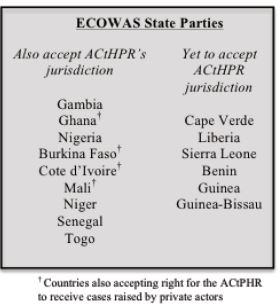 We also expected that even if ECOWAS member states decided to create such a tribunal, they would have included robust political checks to control the judges and their rulings.
What we found—based on a review of ECOWAS Court decisions and more than two dozen interviews with judges, Community officers, government officials, attorneys, and NGOs—was quite different. The member states not only gave Court a capacious human rights jurisdiction, they also rejected opportunities to narrow the Court’s authority.
Our AJIL article emphasizes several interesting dimensions of the ECOWAS Court’s repurposing and subsequent survival as an international human rights tribunal.
We also expected that even if ECOWAS member states decided to create such a tribunal, they would have included robust political checks to control the judges and their rulings.
What we found—based on a review of ECOWAS Court decisions and more than two dozen interviews with judges, Community officers, government officials, attorneys, and NGOs—was quite different. The member states not only gave Court a capacious human rights jurisdiction, they also rejected opportunities to narrow the Court’s authority.
Our AJIL article emphasizes several interesting dimensions of the ECOWAS Court’s repurposing and subsequent survival as an international human rights tribunal.
03
Feb
Talk About the Imperial Presidency!
President Obama has issued the following memorandum concerning US participation in the UN's Mali stabilisation mission: By the authority vested in me as President by the Constitution and the laws of the United States of America, and consistent with section 2005 of the American Servicemembers' Protection Act of 2002 (22 U.S.C. 7424), concerning the participation of members of the Armed Forces...
30
Jan
Ukraine: Popular Protests, Human Rights Reports, and the Push and Pull of Normative Competition
Following up on my earlier posts on the normative aspects of the struggle concerning Ukraine and other former Soviet countries (1, 2, 3) in the run-up to, and the aftermath of, the EU's November summit in Vilnius, where Ukraine had been expected to sign an Association Agreement with the EU. However, the Yanukovich regime backed out at the last minute....
28
Jan
Guest Post: Colangelo–Kiobel and Conflicts of Law
[Anthony Colangelo is Associate Professor of Law at SMU Dedman School of Law.] As my comment to Roger’s initial post noted and my forthcoming piece in the Cornell Law Review explains, like Bill Dodge I view the presumption against extraterritoriality’s operation in Kiobel as going principally to the cause of action allowed by the ATS as opposed to the ATS proper. Though as Roger points out, the Supreme Court did find itself construing the ATS in order to discern whether the presumption applied to the cause of action, making an already messy area of law incoherent in light of the Court’s own most recent precedent, as I noted in an OJ Insta-Symposium contribution last spring. What I’d like to explore now is another question raised by this terrific series of posts: the extent to which state law incorporating international law may authorize suits for causes of action arising abroad after Kiobel. This question is both especially urgent because it involves a potential alternative avenue for litigating human rights abuses abroad in U.S. courts, and especially vexing because it juxtaposes different doctrinal and jurisprudential conceptualizations of the ability of forum law to reach inside foreign territory. On the one hand, the question can be framed as whether forum law applies extraterritorially; on the other, it can be framed as a choice of law among multiple laws, of which forum law is one. These different ways of framing the question are not necessarily mutually exclusive, yet they can lead to radically different results. Namely, Supreme Court jurisprudence stringently applying a presumption against extraterritoriality to knock out claims with foreign elements stands in stark contrast to a flexible cadre of state choice-of-law methodologies that liberally apply state law whenever the forum has any interest in the dispute. The result is a counterintuitive disparity: state law enjoys potentially greater extraterritorial reach than federal law. The disparity is counterintuitive because the federal government, not the states, is generally considered the primary actor in foreign affairs. Indeed, the presumption against extraterritoriality springs directly from foreign affairs concerns: its main purpose is to avoid unintended discord with other nations that might result from extraterritorial applications of U.S. law. If the federal government is the primary actor in foreign affairs, and if the presumption operates to limit the reach of federal law on a foreign affairs rationale, it follows that state law should have no more extraterritorial reach than federal law. Yet at the same time there is a long and robust history stretching back to the founding of state law providing relief in suits with foreign elements through choice-of-law analysis. Hence, not only does the disparity between the reach of federal and state law bring into conflict federal versus state capacities to apply law abroad (or entertain suits arising abroad), it also brings into conflict the broader fields that delineate those respective capacities: foreign affairs and federal supremacy on the one hand, which argue in favor of narrowing the reach of state law to U.S. territory, and private international law and conflict of laws on the other hand, which argue in favor of allowing suits with foreign elements to proceed in state court under state law.
28
Jan
Guest Post: Dodge–The Presumption Against Extraterritoriality Does Not Apply to Jurisdictional Statutes
[William S. Dodge is The Honorable Roger J. Traynor Professor of Law and Associate Dean for Research at the University of California, Hastings College of the Law. From August 2011 to July 2012, he served as Counselor on International Law to the Legal Adviser at the U.S. Department of State, where he worked on the amicus briefs of the United States in Kiobel v. Royal Dutch Petroleum Co. The views expressed here are his own and do not necessarily reflect the views of the State Department or of the United States.] The Supreme Court held in Kiobel v. Royal Dutch Petroleum Co., 133 S. Ct. 1659 (2013), that the presumption against extraterritoriality applies to suits brought under the Alien Tort Statute (ATS). In a recent post, Roger Alford asks whether a federal court sitting in diversity or a state court of general jurisdiction may still hear the federal common law claims for torts in violation of the law of nations that the Court recognized in Sosa v. Alvarez-Machain, 542 U.S. 692 (2004). The answer depends on whether Kiobel applied the presumption against extraterritoriality to the ATS itself or to Sosa’s federal common law cause of action. As a general matter, the presumption against extraterritoriality does not apply to jurisdictional statutes. Putting Kiobel to one side for the moment, I know of only two cases in which the Supreme Court has used the presumption to interpret statutes that might be characterized as jurisdictional. In Argentine Republic v. Amerada Hess Shipping Corp., 488 U.S. 428, 440-41 (1989), the Court applied the presumption to the Foreign Sovereign Immunities Act, and in Smith v. United States, 507 U.S. 197, 203-04 (1993), it applied the presumption to the Federal Tort Claims Act. But both the FSIA and the FTCA codify rules of immunity, which the Court has characterized as substantive, and so neither statute is purely jurisdictional. No one suggests that the presumption against extraterritoriality limits 28 U.S.C. § 1331 (the federal question statute), or 28 U.S.C. § 1332 (the diversity and alienage jurisdiction statute), or 18 U.S.C. § 3231 (the subject matter jurisdiction statute for federal criminal offenses). Yet none of these jurisdictional provisions contain the clear indication of extraterritoriality that would be necessary to rebut the presumption. To take one example, if the presumption against extraterritoriality were applied to 18 U.S.C. § 3231, a federal court would have to dismiss for lack of subject matter jurisdiction a federal prosecution for bombing U.S. government facilities abroad despite the fact that the substantive criminal statute (18 U.S.C. § 2332f) expressly applies when “the offense takes place outside the United States.” That makes no sense, and is not a result that any sensible court would reach. The Supreme Court’s decision in Morrison v. National Australia Bank, 130 S. Ct. 2869 (2010), confirms the distinction between substantive statutes to which the presumption against extraterritoriality applies and jurisdictional statutes to which it does not. In Morrison, the Court used the presumption to limit a substantive provision of the Securities Exchange Act, finding “no affirmative indication in the Exchange Act that § 10(b) applies extraterritorially.” Id. at 2883. But notably, the Court did not apply the presumption against extraterritoriality to the Exchange Act’s jurisdictional provision. To the contrary, the Court specifically held in Part II of its opinion that “[t]he District Court here had jurisdiction under 15 U.S.C. § 78aa to adjudicate the question whether § 10(b) applies to National’s conduct,” id. at 2877, despite the fact that § 78aa contains no clear indication of extraterritoriality, which would be needed to rebut the presumption if it applied. Kiobel is consistent with the distinction that courts applying the presumption against extraterritoriality have long drawn between jurisdictional and substantive statutes. “We typically apply the presumption to discern whether an Act of Congress regulating conduct applies abroad,” the Court noted. 133 S. Ct. at 1664 (emphasis added). The ATS was not such a statute; the Sosa Court had held that it was “strictly jurisdictional.” But Sosa also held that the ATS authorized courts to recognize federal common law causes of action for torts in violation of the law of nations, and it was to those causes of action that the Supreme Court applied the presumption in Kiobel. “[W]e think the principles underlying the canon of interpretation similarly constrain courts considering causes of action that may be brought under the ATS.” Id. (emphasis added). Thus, after reviewing the text and history of the ATS, the Court concluded “that the presumption against extraterritoriality applies to claims under the ATS, and that nothing in the statute rebuts that presumption.” Id. at 1669 (emphasis added). To be clear,
26
Jan
China’s Crackdown on the Uighurs and the Case of Ilham Tohti
The New York Times reports that Ilham Tohti, a Uighur economics professor, has been arrested by Chinese authorities for separatism and inciting ethnic hatred. A number of his students are also seemingly being detained. Tohti is just one person and, perhaps unfortunately for him, his case is emblematic of larger regional tensions in China and Central Asia. The Uighurs are a Turkic-speaking ethnic group, about...
24
Jan
Does the Presumption against Extraterritoriality Apply to the ATS or the Underlying Federal Common Law Claims?
I just completed a draft essay on Kiobel for the Notre Dame Law Review (the symposium will include luminaries such as A.J. Bellia, Doug Cassel, William Castro, Bradford Clark, Bill Dodge, Eugene Kontorovich, Thomas Lee, Michael Ramsey, Ralph Steinhardt, Beth Stephens, and Carlos M. Vázquez). To my surprise after careful reflection there remains an important question that I have not...